

Benefits of Hybrid Internet for Keeping Critical Business Applications Stable (ERP, SAP, SCADA)
In today’s digital era, businesses depend heavily on technology to operate efficiently. The benefits of internet bonding are increasingly felt by companies that rely on stable internet connections to run critical applications such as SCADA, SAP, ERP, CRM, and HRM. Ensuring uninterrupted access to these applications, even during internet disruptions, is essential. A stable, reliable IP address is one of the most crucial aspects of any network infrastructure.
Internet Bonding vs Dedicated Leased Line: Which Is More Reliable?
Traditionally, dedicated leased lines have been the go-to choice for businesses that need stable, reliable static IP infrastructure. However, internet bonding has grown increasingly popular thanks to its reliability, redundancy, and flexibility.
What Is Internet Bonding and How Does It Work?
Internet bonding is a system in which 2–3 or more connections from different ISPs are combined (bonded) under a single designated static IP address. This system helps ensure minimal disruption to your business processes, since internet bonding typically enables faster transfer speeds, internet redundancy, and stronger overall internet security.
Case Study: Securing Critical Business Applications with Internet Bonding

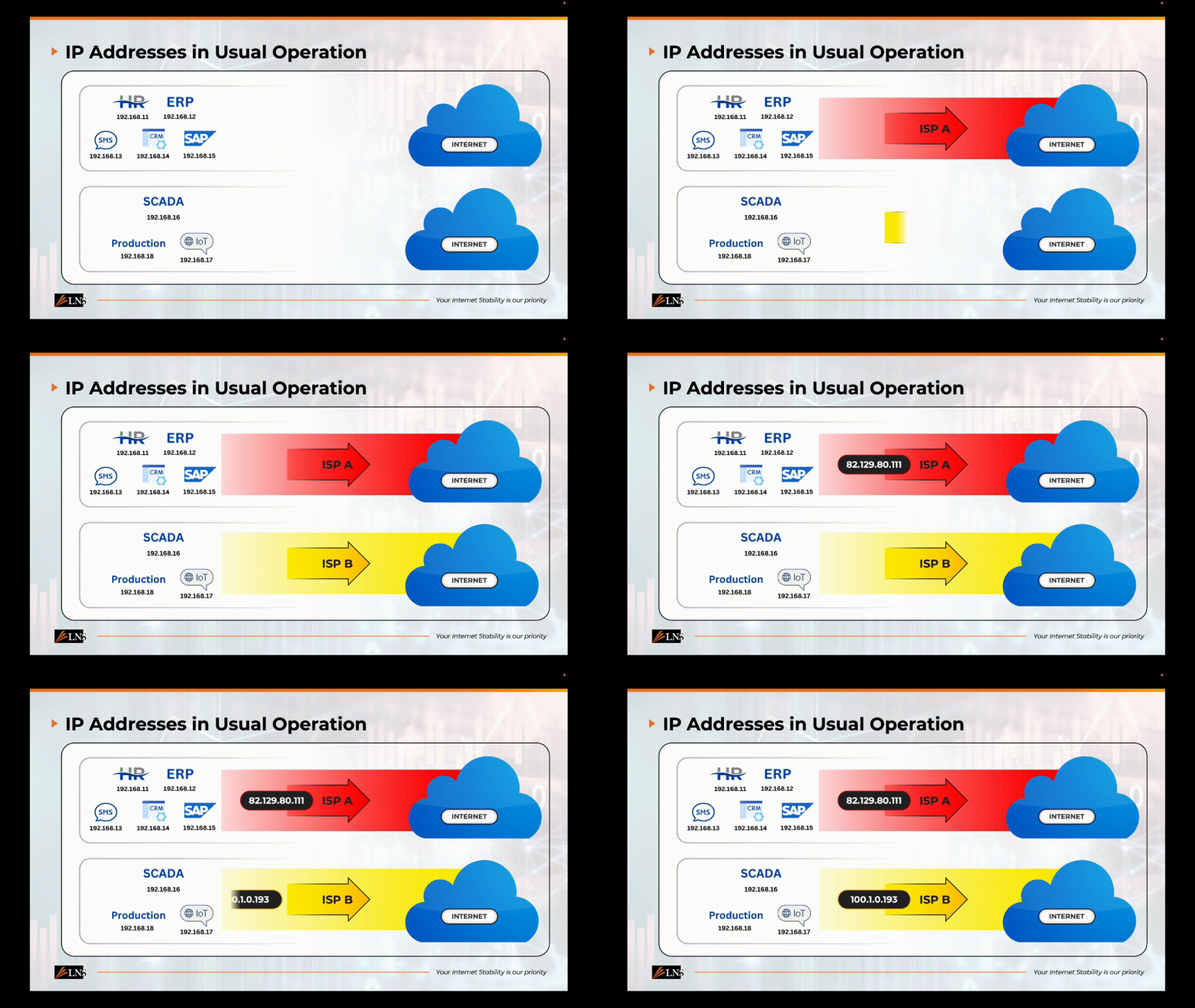
Let’s take the example of a domestic poultry farm’s Head Office (HQ) that had two dedicated leased lines. One leased line (Line A) connected to 5 (five) essential applications: HRM, ERP, SMS gateway, CRM, and SAP. The other leased line (Line B) connected to 3 (three) applications: SCADA, production, and IoT automation.
When Line A went down, all 5 critical applications immediately stopped working. The IT manager had to re-route the application’s IP address to Line B (100.1.0.193) to restore internet access. This re-routing process was tedious and time-consuming, and could cause significant disruption to business operations.
With LNS’s bonded internet solution in place, if ISP A experiences a disruption, LNS’s Next-Gen bonded internet instantly provides backup from ISP B and ISP C simultaneously. This allows all critical applications to keep running smoothly using the same static IP address, with no need for any IP address re-routing. As a result, the risk of critical application disruption is significantly reduced, and disruption to your business processes is kept to a minimum. On top of that, Line A and B can be combined together with Line C acting as redundancy, using the LNS solution.
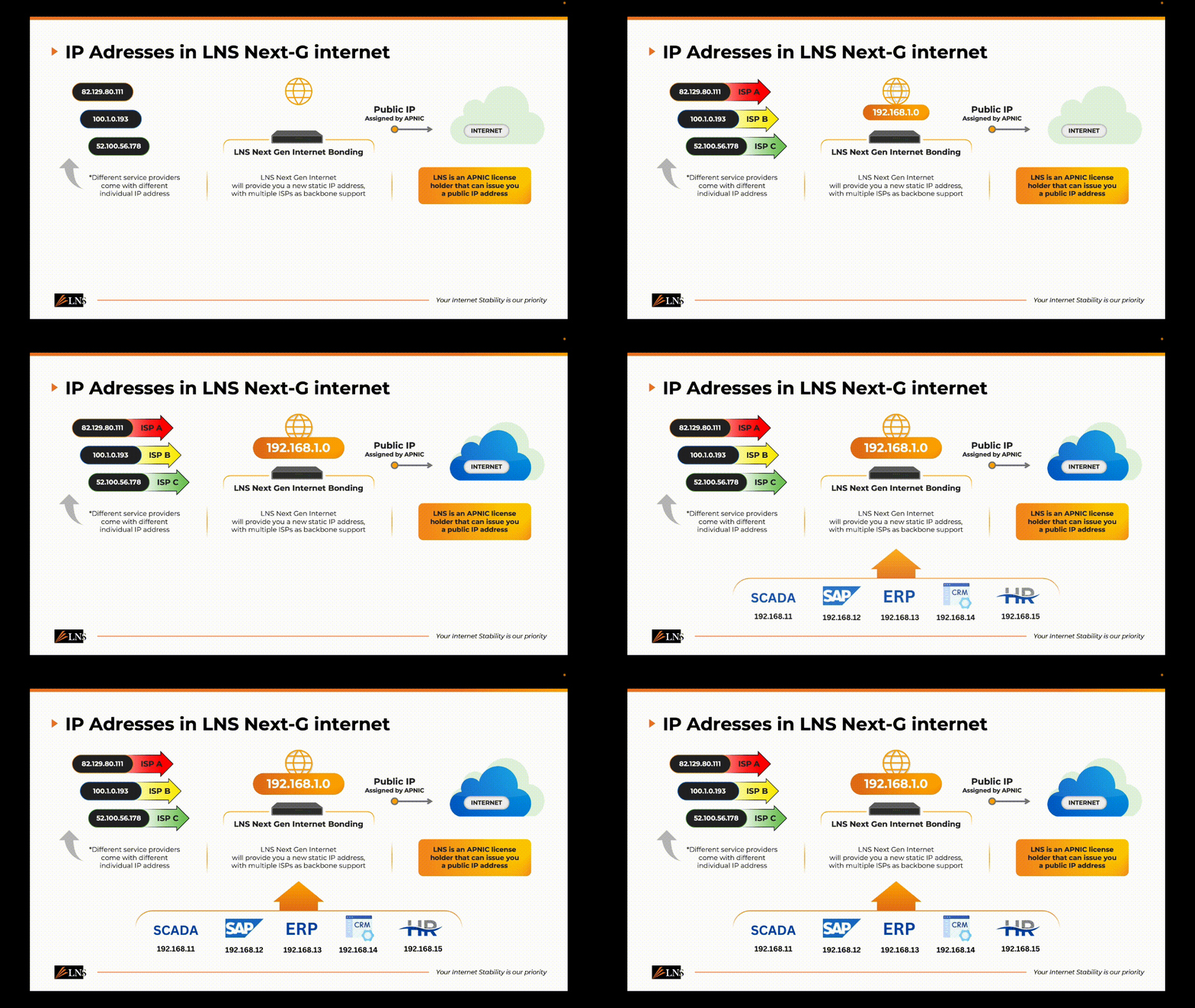
Beyond that, bonded internet can also combine microwave and 4G LTE connections, serving as an excellent internet redundancy alternative. After switching to bonded internet, the domestic poultry farm no longer experienced downtime, and its operations continued without interruption. They were even able to add new applications to the network without worrying about network disruption or bottlenecks.
Benefits of Hybrid Internet: Faster Data Transfer for SCADA and IoT
Another major advantage of hybrid internet and internet bonding is significantly faster data transfer speeds. This is especially beneficial for enterprises that rely on critical business applications such as SCADA, cloud ERP, or industrial IoT automation requiring uninterrupted, real-time telemetry and data synchronization.
Stronger Security for Critical Business Applications with Hybrid Internet
On top of speed and redundancy, internet bonding also delivers stronger overall network security. Because traffic is encrypted and distributed across multiple independent ISPs, it becomes far more difficult for external attackers to intercept data or disrupt your operations.
To learn more about LNS 360 Hybrid Internet, contact LNS Malaysia today. As a licensed APNIC member, we provide a dedicated static IP address for your bonded connections ensuring comprehensive security, regulatory compliance, and stable connectivity for your critical business applications.
Protect Your Critical Business Applications Against Downtime.
Safeguard real-time telemetry, automated field controls, and mission-critical transactions from carrier outages. Deploy carrier-grade failover and multi-provider bonding engineered to withstand harsh environments and unpredictable signals.